July 18, 2008

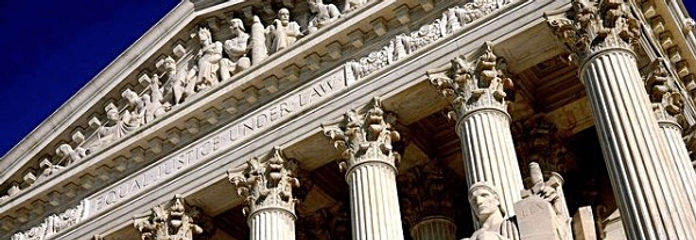
Huge Election Issue: Judges

The unprecedented growth of the Judiciary's hand in influencing social policy is apparently gaining quite a bit of public attention.

"A total of 87 percent say a President's power to appoint Supreme Court justices is 'very important' or 'somewhat important' in their vote this November," according to yesterday's Quinnipiac poll.

"Looking at the U.S. Supreme Court and social issues, American voters narrowly disapprove 43 - 39 percent of the job the Court is doing, the lowest rating in five years of Quinnipiac University surveys on the Court and the first time the Court has received a negative score. Voters say 42 - 33 percent that the Supreme Court is moving in the wrong direction. While 33 percent of voters say the Court is "about right," 25 percent say it is too liberal and 31 percent say it is too conservative."

Judges Boycott & Suggestions for Sen. Reid

Yesterday marked the one-year anniversary of Bob Conrad’s nomination to the Fourth Circuit Yet Judiciary Chairman Leahy has not allowed Conrad even a hearing. Those judicial nominees who have had hearings and await committee votes fared no better yesterday. Leahy did not include any of them on the agenda for yesterday’s Judiciary Committee meeting. In protest, the Republican members of the committee boycotted the meeting. They cited Democrats’ use of "fancy footwork … [and] every stalling tactic in the book” to block nominees, including “claiming that they are ‘too qualified’ and by citing a mythical ‘Thurmond rule’ that they previously admitted doesn’t exist.” (Sens. Grassley & Brownback respectively).

But the most remarkable development of the day was Majority Leader Reid’s claim on the Senate floor that he “can’t ever remember going home” and hearing concern about the “judges problem.” Apparently, Sen. Reid doesn’t get around much. But we have a few suggestions about who he should talk to if he wants to more accurately assess voters’ concern with the judges issue.

Reid should start with the citizens of the Fourth Circuit, who have been suffering with the substantial delays in justice caused by a vacancy rate of up to 33%, with some seats left vacant for the entire length of the Bush Administration. The 21 GOP Congressmen in the Fourth Circuit have had to plead with the Senate to take action because “excessive vacancies may be taking a serious toll on the administration of justice.”

Next, Sen. Reid should talk to pollsters like Rasmussen, who found that GOP voters rank the appointment of Supreme Court justices as a more important presidential election issue than the war in Iraq, as well as the American Bar Association, which found that Americans, by an almost 2-to-1 margin, believe judicial activism “seems to have reached a crisis” (4 ABA Journal eReport 40, 9/30/05).

Reid should also chat with his predecessor, former Majority Leader Tom Daschle, whose narrow 2004 loss is widely blamed on his obstruction of President Bush’s judicial nominees, an issue emphasized by his opponent. Or Reid could chat about the 2002 Senate races with Karl Rove, who said:
"There's no doubt in my mind that we won races all throughout the country [on the judges issue]. We won the Senate race in South Carolina – judges; won the North Carolina race – judges; won the Georgia race – judges."
If Reid is still not convinced that voters care about judges, he should visit political analyst and professor Larry Sabato at the University of Virginia. Sabato found that the judges issue "was one of Bush's best issues in the campaigns of 2000 and 2004" (Congress Daily PM, 7/18/06). If he prefers to look ahead, Sen. Reid can consult his colleague Sen. Obama, whose campaign signaled the importance of the judges issue by instructing surrogates to remind voters of the difference between the judges he and McCain would appoint.

Finally, Sen. Reid should ask Democrats on the Judiciary Committee why they support the Federal Judgeship Act, which would add 50 federal judgeships. The purpose of the Act, in Chairman Leahy’s words, is to “meet the needs of circuits and districts overwhelmed by growing caseloads.” (emphasis added). If Americans don’t care about the delays in justice caused by a shortage of sitting judges, then why are Reid’s colleagues planning to waste taxpayers’ money on new judgeships?

Sen. Reid’s remarkable claim that his constituents don’t care about the “judges problem” came as part of his excuse for denying Republicans the floor time they wanted to discuss the pending vote on two New York district court nominees. Instead, Reid rushed their confirmation through before a debate could take place. Which leaves us wondering what Reid is so afraid of hearing. Perhaps it’s the latest figures from the nonpartisan Congressional Research Service, which show that Democratic obstruction has caused unprecedented delays in the judicial confirmation process. Relative to President Clinton, Bush’s circuit court nominee have waited 46% longer if confirmed, and more than twice as long if not confirmed.

July 14, 2008

There is No "Thurmond Rule"

The oral testimony and written statement of expert witness Denis Steven Rutkus, a federal judiciary specialist for the Congressional Research Service (CRS), confirmed Senator Specter's suspicions today regarding the so-called "Thurmond Rule" at the Senate Republicans Committee hearing. (Transcript available here).

The phrase was coined after the late Senator Strom Thurmond for his role in supposedly encouraging presidential candidate Ronald Reagan and Senate Republicans to stall on President Carter's remaining judicial nominees in the election year of 1980. However, as the CRS report points out, the "The Judiciary Committee continued to hold hearings and report judicial nominations during August and September ... The Senate in turn, in September, confirmed 12 judicial nominations (11 district, one circuit)." So even the initial utilization of "Thurmond Rule" by Senate Republicans during the 1980 election is questionable at best. And looking at how many judicial nominees have been confirmed in election years ever since then, Mr. Rutkus comments that we have not seen its effective application until now. As reported in Jurist, "the average time for the Senate to take final action on a successful district court nominee has almost tripled [nomination chart]."

Chairman Leahy, spurred on by interest groups like People for the American Way, has increasingly relied upon the "Thurmond Rule" as if it is a legitimate procedural mechanism to stall votes on well qualified and noncontroversial nominees to vacant emergency benches. To the contrary, Rutkus summarized his nonpartisan research by concluding, "There is no written rule regarding the slowing down of judicial confirmations in an election year."

Other witnesses at the hearing included Professor John McGinnis of Northwestern Law School, Former U.S. Attorney Roscoe C. Howard, and Assistant Executive Director of the North Carolina Bar Association David Bohm. All expressed deep concerns that the the use of the "Thurmond Rule"' to slow down the confirmation process during election years is resulting in unnecessary costs and delays, forum shopping, and loss of faith in the judicial system.

Senator Cornyn suggested that it is time for the Senate to move beyond these partisan maneuvers and enter a new chapter of responsible judicial confirmations: "These nominees [i.e. P. Keisler, B. Conrad, S. Mathews, R. Rosenstien, etc.] have not had the chance to be heard. And some of them have suffered personal attacks with no chance of rebuttal ... The judicial nomination process is broken ... No one can remember how the feud began but we should bring an end to it. Now is the perfect time to fix this, as we do not know who will be the president next year."

C-SPAN Alert and NY Times v. Reality

C-SPAN3 has announced a live broadcast of today’s Senate Republican Conference forum on the judicial confirmation process. Beginning at 2:00 pm today, Sen. Arlen Specter and seven of his Senate colleagues will investigate the politicization of the confirmation process and the legitimacy of the “Thurmond Rule,” as they question witnesses from the Congressional Research Service, Northwestern University Law School, and the North Carolina Bar Association. Watch the forum in Russell Senate Building room 385 or on C-SPAN3.

Speaking of judges, former New York Times Supreme Court reporter Stuart Taylor provided the paper with a much-needed reality check in his column yesterday, after a Times editorial claimed that the Supreme Court was “teetering on the brink” of “far-right” disaster in its just-ended term.

As Taylor points out, several of the “far-right” decisions the Times found so disturbing this term were written or joined by the Court’s liberal Justices. Apparently only Justice Ginsburg escaped the conservative Kool-Aid:
"A new wrinkle in this summer’s assessments is that the conservative cabal appears to have co-opted liberal Justices Stephen Breyer, David Souter, and John Paul Stevens."

As we noted following the Court’s Boumediene (Guantanamo) decision last month,

“While it’s certainly true that the Court has drifted right of the New York Times, the nation’s law faculty, and the typical elite cocktail party, the dirty little secret is that the Court is decidedly centrist when compared to the American people. The hysteria about the Court’s ‘right wing assault’ on abortion, desegregation, and the separation of church and state has obscured the fact that large majorities of the public oppose partial-birth abortion and racial preferences and favor some role for religion in the public sphere.”

Taylor goes even further and provides specific poll results with lopsided majorities in concluding that

“[On] six of the most contentious subjects that come before the justices on a securring basis: abortion; race; religion; the death penalty; gay rights; and presidential war powers. On every one of them, the Court’s precedents are to the left of, or very close to, the center.”
“The point,” Taylor says, “is that it’s misleading to brand as ‘far-right’ and ‘radical’ positions that in fact are more liberal than, or near the center of, mainstream public opinion.”

But what about the Times’s argument that “the court is just one justice away from solidifying a far-right majority that would do great damage?” That, of course, assumes that there are already four dangerously conservative justices on the Court. However, as Taylor points out,

“Roberts and Alito are ‘far-right’ and ‘radical’ (as Times columnist Frank Rich has called them) only to people who are themselves more than a little bit to the left on he public opinion spectrum.”

In the last paragraph of the Times editorial, we learn that the paper’s hysterics about the just-ended Supreme Court term are intended as a warning to voters “when they go to the polls in November.” If the Times editorial board actually believes that focusing on the 2007-08 term will scare Americans into voting Democratic, they should review the poll results in Taylor’s column and ask themselves whether the Court’s decisions last month expanding the rights of child rapists and foreign terror suspects has made Reagan Democrats and other swing voters hungry for a more liberal Supreme Court.

Finally, although the Times makes itself an easy target, it is somewhat unfair to focus just on that paper. As Taylor notes, hallucinations about right-wing bogeymen running the Court extend to a “sizable slice of the journalistic-academic-cosmopolitan world typified by The New York Times’ editorial page.”

June 26, 2008

Keisler Praised by IG, Obstructed by Dems

Has Judiciary Chairman Patrick Leahy no shame when it comes to judicial nominees? We’ll find out in the coming months by watching whether he continues to deny a committee vote to D.C. Circuit nominee Peter Keisler, a former Assistant Attorney General at the Justice Department. Never mind that Keisler was nominated to the D.C. Circuit two years ago and testified to rave reviews at his Judiciary Committee hearing in August 2006. Sadly, we’ve become all too accustomed to such outrageous delays since Senate Democrats announced plans to block judicial nominees for purely ideological reasons back in 2001.

The real test for whether the shame center in Leahy’s brain is still functioning is whether Leahy continues to block Keisler now that the former Assistant Attorney General has been praised by the DOJ Inspector General’s report for standing up to the very politicization of the Department that Leahy has spent the last year denouncing. Stay tuned as we wait to see whether Sen. Leahy will sink to a new low. For now, here are some thoughts on Peter Keisler and the IG’s report from Sen. Jon Kyl at today’s Judiciary Committee meeting and Collin Levy in today’s edition of WSJ.com's Political Diary.

Senator Kyl (seconded by Sen. Specter):
“According to the [Inspector General’s] report I’m quoting, ‘a few DOJ political employees objected to the apparent use of political or ideological considerations in the hiring process, such as Assistant Attorney’s General Peter Keisler and Aileen O’Connor, and they should be credited for raising their concerns.’ I note this with some bit of irony because … one of the things that [Keisler] said in questioning this [hiring] practice and procedure was that … it must be motivated by politics … It seems to me that one could characterize opposition to Peter Keisler in the same way, and given the fact that his nomination has been pending now for almost 2 years, and there is still plenty of time to confirm his nomination, I would hope that my colleagues who have heretofore opposed that would reconsider in the light of the IG report”
Collin Levy, Political Diary:
“Democrats are happily trumpeting the recent report from the Justice Department's Inspector General over alleged political interference in hiring decisions by the Bush Administration. … In the report, Mr. Keisler comes across as a model of even-handedness. … In particular, Mr. Keisler defended the qualifications of a Harvard law school grad whose resume listed a job with Planned Parenthood. Mmmm, that doesn't sound like the right-wing zealotry that Senate Democrats claim to detect … Senate Democrats routinely criticize politicization of the Judiciary. In Mr. Keisler, though, they've spent two years punishing a man who actually fought politicization even when the spotlight was elsewhere.”

June 25, 2008

Obama Disagrees with The Supreme Court

No love for poor old Justice Anthony Kennedy. First, John McCain calls his him out for writing one of the worst opinions in American history, and now this:

Bloomberg: "The rape of a small child, 6 or 8 years old, is a heinous crime, and if a state makes a decision that under narrow, limited, well-defined circumstances the death penalty is at least potentially applicable, that does not violate our Constitution,'' Obama said at a press conference in Chicago.

But wait ... Justice Kennedy says that capital punishment for the brutal rape of children does violate our Constitution. Is this the same Constitution we are talking about here .. the same Constitution Obama and Kennedy agreed on in Boumidiene two weeks ago? Maybe Obama needs to illuminate us about WHY he thinks this Supreme Court decision is the wrong way of interpreting our Constitution. Is it wrong because of Obama's own values or is it wrong because Obama believes Kennedy used a poor standard of interpreting what does and does not qualify as a constitutional violation? Many questions for the young Senator from Illinois. We look forward to the debates.

Obama, McCain, and Today’s Rape Decision

We won’t waste much time explaining why today’s 5-4 Supreme Court decision prohibiting the death penalty for rape – including the aggravated rape of an 8-year-old at issue in this case – is a classic example of judicial activism. Justice Kennedy’s resort to lofty but vacuous language in the majority opinion is enough to demonstrate that even Kennedy knew he was playing moralist and policy maker rather than objective interpreter of the Constitution. For example, in today’s aptly named Kennedy v. Louisiana, Justice Kennedy opined that “

“Evolving standards of decency must embrace and express respect for the dignity of the person … When the law punishes by death, it risks its own sudden descent into brutality, transgressing the constitutional commitment to decency and restraint.”
John McCain immediately denounced the decision, but Sen. Obama has so far been quiet. Now, we express no opinion on whether allowing the death penalty for rape is good policy, but we have a very definite opinion on whether judges should serve as the nation’s self-appointed moral arbiters. Thus, we are, to say the least, concerned by Obama’s belief that difficult cases

“can only be determined on the basis of one's deepest values, one's core concerns, one's broader perspectives on how the world works, and the depth and breadth of one's empathy. … [I]n those difficult cases, the critical ingredient is supplied by what is in the judge's heart.”
If Sen. Obama’s conception of “empathy” for criminal defendants includes leniency for child rapists, then Americans will not be happy with the judges he appoints if elected president. On the other hand, if Obama believes that Justice Kennedy went too far today in following his heart rather then the text or original understanding of the Sixth amendment – banning “cruel and unusual punishments” – then today’s decision is the perfect opportunity for him to say so.

More generally, Sen. Obama complains that the Supreme Court has become too conservative and promises to appoint justices that share his heart-based judicial philosophy. That leads to an obvious question for the senator:

If a Court that grants habeas corpus rights to enemy combatants for the first time in history, and places more importance on elite opinion than the considered judgment of Louisianans about how to best protect their children, is too conservative, then what precisely do you hope a more liberal Supreme Court under President Obama would do?


Update (June 25): At a press conference late today, Sen. Obama commented on the Kennedy v. Louisiana decision in reaction to a reporter’s question:
“[I]f a state makes a decision that under narrow, limited, well-defined circumstances, the death penalty is at least potentially applicable, that that does not violate our constitution. Now, I think had the Supreme Court said we want to constrain the ability of the states to do this to make sure that it’s done in a careful and appropriate way, that would have been one thing. But it basically had a blanket prohibition and I disagreed with that decision.”

June 23, 2008

Obama & Affirmative Action Anniversary

Today marks the fifth anniversary of the Supreme Court’s 2003 landmark decision in Grutter v. Bollinger – involving race-based admissions at the University of Michigan – which held that the educational benefits of diversity can justify racial preferences in admissions, while also declaring that racial preferences should end within 25 years (by 2028).

We hope that journalists will take this opportunity to ask the presidential and Congressional candidates where they stand on the public and private use of racial preferences in education, employment, and contracting, and what they would do to facilitate the end of preferences by 2028. After all, it is the President and U.S. Senate that, by shaping the Supreme Court, will largely determine the future of affirmative action. And it is the President and Congress that, for example, mandate racial preferences in federal contracting, and could modify Title VI of the 1964 Civil Rights Act to make it even clearer to the courts that the “no” in "No person … shall … be subjected to discrimination” means no.

We’re particularly interested in hearing Barack Obama’s answers to the questions above, both because he has campaigned on transcending racial divisions and because he finds himself in the “Nixon goes to China” position of being the person best situated to end racial preferences. To his credit, Mr. Obama acknowledged in his Philadelphia speech that “anger exists within segments of the white community” over preferences for minorities, and that dismissing the anger “as misguided or even racist … widens the racial divide.” Now, it’s time for Obama to explain how he would address the “legitimate concerns” that he concedes are behind the white resentment.

Just as importantly, we would like to know what Mr. Obama’s preferred judicial philosophy means for the future federal court decisions that may well determine the fate of racial preferences. What we do know is that Obama has been unabashed about the type of judges he would appoint:
"We need somebody who's got the heart, the empathy, to recognize what it's like to be a young teenage mom. The empathy to understand what it's like to be poor, or African-American, or gay, or disabled, or old. And that's the criteria by which I'm going to be selecting my judges."
We would have preferred to hear Obama state that he would select judges who will objectively interpret the law. But that said, we wonder how his activist judicial philosophy would be applied to future affirmative action cases. Does understanding what it's like to be African-American imply that racial preferences should be upheld? Or does understanding what it's like to be poor mean that it’s wrong to give affluent minorities job and admissions preferences over poor whites? Alas, that is the problem with an activist judicial philosophy – it grants nearly absolute discretion to judges.

The current state of the law concerning race-based admissions is just one example of the legal morass that results when activist judges stray far from the text of the constitution and statutes they are supposed to be interpreting. Neither critics nor supporters of affirmative action can claim to understand the applicable legal standard in the wake of Grutter and its companion case Gratz v. Bollinger. It’s a standard that permits universities to seek a “critical mass” of minorities, but absolutely forbids quotas. It permits schools to use large racial preferences, but only if they’re disguised as part of a broad-based search for intellectual diversity.

That’s not to say that, objectively, the meaning of the Constitution’s Equal Protection Clause – the focus of Grutter – is crystal clear. One can make an argument, albeit an abandoned one, that the Clause is intended to protect only African Americans (see the legislative history of the 14th Amendment). On the other hand, one can easily argue that “equal” means equal with no ifs, ands, or buts. What one can’t plausibly argue – at least not without a lot of intellectual dishonesty – is that the Equal Protection Clause applies in full force to all racial minorities, somewhat less to Caucasians, and virtually not at all if it will negatively impact diversity in higher education. Nonetheless, that’s exactly what the Supreme Court has said, and we’re stuck with the resulting morass for the foreseeable future. Wouldn’t we all be better off if judges would stick to the law and leave policy making to legislators?

June 20, 2008

Judge Conrad and Leahy the Lapdog

Anyone attending yesterday’s press conference for Fourth Circuit nominee Bob Conrad – sponsored by Sen. Specter and attended by Sens. Dole, Burr, Hatch, and Sessions – must have walked away shaking their head over Senator Leahy’s refusal to give Judge Conrad a hearing. Not only is Conrad exceptionally qualified – he received the ABA’s highest rating and was overwhelmingly confirmed by the Senate when nominated to be a district court judge and a U.S. Attorney – but he also has clearly demonstrated the compassion that Democrats say they want in a judge. Witness one of the speakers at yesterday’s press conference, a former gang member who said Judge Conrad “could have given me a life sentence. Instead he came to meet my mother and father." Conrad helped the young man attend college and find a job.

So why is Sen. Leahy refusing to give Judge Conrad a hearing? Leahy has charged that Conrad is “anti-Catholic,” but that’s all the more reason to hold a hearing in which Conrad can be confronted with the charge. Perhaps Leahy fears that he will look foolish if forced to repeat the charge. After all, as Quin Hillyer pointed out in the American Spectator yesterday, the charge is preposterous:
"[T]he nominee himself is Catholic, and … the incident to which the chairman referred involved the nominee writing a letter to the editor defending a traditional Catholic priest from insults leveled at the priest by a progressive Catholic nun. How a defense of a Catholic priest can be characterized as being 'anti-Catholic' is beyond me."
To understand why Leahy is blocking this terrific nominee, one need only look to the collection of ultra-liberal organizations that call the shots on which Bush nominees Senate Democrats will block. Richard Burr, one of Judge Conrad’s home state senators, summarized the problem in an interview with Media General:
"Burr, in an interview, said he believed Leahy was acquiescing to groups like [People for the American Way]. ‘Clearly, these outside groups have told Sen. Leahy, don't do this,’ he said.”
Curt Levey, the Committee for Justice’s Executive Director, made the same point in more detail when addressing yesterday’s press conference. Here are his remarks:

“Others here have already eloquently described why Judge Conrad is a great nominee, so I won’t try to match their eloquence on that point. It suffices to say that if Bob wasn’t such a solid nominee, Senate Democrats wouldn’t be blocking him. They don’t fear the mediocre nominees.

“And groups on the Left – like People for the American Way (PFAW), the ACLU, and the Alliance for Justice – who favor judicial activism wouldn’t be campaigning against Judge Conrad if they weren’t certain that he’ll refuse to be an activist judge and will refuse to rule for the most politically correct party when the law requires otherwise.

“Don’t doubt for a second that it’s the groups on the Left who are behind the obstruction of Conrad and George Bush’s other judicial nominees. All you need do is look at the Democratic Judiciary Committee memos disclosed in November 2003 that made it quite clear that organizations like PFAW were calling the shots on which judicial nominees Democratic senators would obstruct.

“These organizations accuse Judge Conrad of being out of the mainstream, but let me remind you of what these groups consider mainstream. These are the same groups that argue that anti-polygamy laws are unconstitutional. These are the same organizations that are fighting to delete ‘under God’ from the Pledge of Allegiance and to strike down laws protecting children from Internet pornography. These same groups are campaigning to give drivers licenses to illegal aliens, while fighting against the deportation of aliens convicted of crimes and virtually every aspect of the War on Terror.

“No wonder these groups love judicial activism. Their agenda is far too unpopular to be enacted any other way, as we saw most recently with the gay marriage decision in California and the U.S. Supreme Court’s Gitmo decision.

“Those of us here today worry about the high vacancy rate and judicial emergencies on the Fourth Circuit. But, as John McCain said last month, for the people opposing Bob Conrad, the only judicial emergency is the possible confirmation of a judge who
doesn't meet their own narrow test of ideology.

“When nominees like Judge Conrad fail that test, the charge by opponents is always the same. The nominee is accused of being insensitive to women, minorities, and civil rights in general. In this case, Sen. Leahy also threw in the anti-Catholic charge.

“But if there’s any bigotry here, it’s on the part of Senate Democrats and their allies on the Left. I’m talking about their consistent bias against white male nominees from the South, like Judge Conrad. Except for the two instances in which a Democratic senator picked the nominee, every time President Bush nominated a southern white male to the appeals courts – 11 times in all -- Senate Democrats tried to obstruct the
nomination. And each time they’ve subjected the nominee to the same personal attacks that exploit the worst stereotypes about southerners.

“For a party that’s supposedly trying to win over Reagan Democrats and outherners, this blatant bigotry against southern white men doesn’t seem like a great strategy. But I guess we’ll see what the voters have to say about that.”

For a further discussion of the agendas of the groups opposing Judge Conrad, see here.

See also:
Sens. Burr and Dole on Judge Conrad.
Sen. Hatch on Judge Conrad.

June 19, 2008

338 Days and Still Waiting...

Senator Specter (PN) held a press conference this afternoon in support of Bob Conrad, Fourth Circuit Court of Appeals nominee who has been waiting nearly a year just to have a hearing on his nomination.

Joined by Conrad's home state senators Elizabeth Dole (NC) and Richard Burr (NC), as well as Orrin Hatch (UT) and Jeff Sessions (AL), who sit on the Senate Judiciary Committee, Specter recited Conrad's undeniably superb record, endorsements, and qualifications in calling for his expedient confirmation.

The American Bar Association has unanimously voted Conrad "Well Qualified" - their highest possible rating. Magnanimous letters of support have also been submitted from the President of his alma mater at Clemson University, North Carolina Bar Association, Chairman of the South Carolina Democratic Party, and President of the Catholic League for Religious and Civil Rights (the latter debunks claims that any anti-Catholic statements were ever made by Conrad, who is himself a devout Catholic, and shows such claims to be nothing more than political cheap shots at man with a spotless record).

Also in attendance were several people whose lives Conrad has personally touched. His former supervisor at the United States Attorney's Office stated that, "[Conrad's] mantra was the pursuit of excellence. He lived life as we hope most judges would." A second grade Massachusetts schoolteacher shared fond memories of how Coach Conrad inspired her and twenty other young women on her youth basketball team to develop strong character on and off the court. Most poignant was a gentleman who had been a member of a street gang in his teenage years. Conrad's love for basketball and his willingness to see potential in the troubled young man turned out to be an extraordinary blessing. "I came to Judge Conrad on his docket ... He could have given me a life sentence. Instead he came to meet my mother and father." Conrad helped the young main gain tuition assistance to attend college and even arranged several job opportunities for him. Today, he is an employed and eloquent family man who is involved with community outreach. "I want to thank [Bob Conrad] for taking that time."

It should be noted that Republicans and Democrats alike have praised Conrad's experience, fairness, and sound decision making. Former Clinton Administration Attorney General Janet Reno previously remarked, "I am impressed with his judgment ... and his knowledge of law. He is an excellent prosecutor." Senator Dole stressed that she has great admiration and respect for Judge Conrad and that "it is appalling that a person of his quality has not been given a fair hearing ... This is a judicial emergency seat [in the Fourth Circuit which counts four vacant benches and an extraordinarily burdened caseload] ... It is an incredible injustice to him."

“No individual should have their life on hold for 338 days like Bob Conrad,” said Sen. Richard Burr, R-N.C., at a press conference. “It’s time to lay politics aside and fill this very important vacancy.”

Senators
Leahy (VT), Whitehouse (RI), and Feinstein (CA) have recently scolded the Senate Minority for undermining the integrity and character of their hearings with obstructive interruptions. Interesting to point out that these are among the same group of Senators who have thus far prevented a hearing for such an uncontroversial man of proven integrity and character as Bob Conrad.

June 16, 2008

Tit for Tat

That is the name of the game in today's U.S. Senate. Two Sixth-Circuit Court nominees - White and Kethledge - and one District Court nominee - Murphy - were advanced by the Senate Judiciary Committee last Thursday afternoon. But not until a few jabs were thrown.

TIT: Following opening remarks by Chairman Leahy (D-VT) and ranking member Specter (R-PA), the dialogue spiraled into an unbridled display of finger-pointing. Senator Durbin (D-IL) launched a storm of bickering about who is to blame for the recent stalling and gridlock. He began by denouncing the heightened use of filibusters. “75 filibusters this session alone (and with months to go) by the Minority has led to a breakdown.” After throwing the first punch, he regressed into a "why cant we all just get along and do our jobs" appeal that encouraged moving ahead through the use of amendments and holding more productive debates. Senators Whitehouse (D-RI) and Feinstein (D-CA) added that the recent objections and use of procedural mechanisms such as the two hour rule by Minority Leader Mitch McConnell (R-KY) and company are shamefully hurting the integrity and character of Senate hearings. "My hearing was stopped dead in its tracks. This just isn't right ... i want to appeal to the other side to cease and desist," said a very peeved Senator Feinstein. At one point, Chairman Leahy even threatened to hold "these hearings on Saturdays" if the obstructions continue.

TAT: Senator Kyl (R-AZ) responded, "there have been many shots fired and it is easy to pick one and blame the other side for starting all of this ... and it is easy for the Majority to talk about the objections and stalling of bills, but let's begin by talking about [stalled judicial] confirmations." Senator Sessions (R-AL) added that nominees Keisler and Conrad are unanimously well qualified and "have been waiting much longer [than White] ... we are not even close to the average 15 to 17 confirmations." Senator Hatch (R-UT) defended the use of the two hour rule and other objections as tools the Minority rightfully has at its disposal to employ them if it has to.

And so they sparred back and forth for over an hour, until Senator Biden (D-DE) offered to, in his own words, "Inject a bit of reality into all of this." This reality is that we are in a presidential election year and there is a good reason for a party who sees they could win the election to hold out on confirmations, he explained. "These are lifetime appointments. The president’s preference is young judges in their 40s with a streak of conservative records … The idea that the president is going to get every single one of his nominations … It's just not going to happen, it never happens … There are 98 other senators here [besides the Chairman and ranking member] ... the President should realize that and be more useful with who he nominates." So basically, a president should not hope for his judicial nominees to be confirmed in his final year in office. It therefore should not be a surprise to Senator Biden if Republican Senators were to by chance remember such justifications in a potential Obama administration four years from now. Is Senator Biden short sighted or is he right that this is just the way it is?

Within the final half hour of the meeting, they settled down to debate and vote on the three candidates, who all passed and now stand for confirmation on the Senate floor. The delay tactics are set to continue as there is still a long way to go for approving a reasonable number of judicial nominees. Surely, the Majority knows exactly why the Minority is employing frustrating procedural tactics by now and one has to wonder what all that bickering and finger pointing is worth. It begs the question: Why can't they skip the foreplay and get down to business, debate the nominees' records, vote, and go home early?

June 13, 2008

Reagan Democrats and Enemy Combatants

By now, you’ve likely heard plenty of analysis of whether yesterday’s Boumediene decision by the Supreme Court – striking down the heart of the Military Commissions Act of 2006 (MCA) and bestowing the right of habeas corpus on terror suspects held at Gitmo – was correctly reasoned. So take a break from that debate and consider a few related questions about judicial activism, the impact of Boumediene on the election, and the mystery of the missing conservative Supreme Court:

1) The Supreme Court showed little deference to Congress, which enacted the MCA by large majorities in both houses. So why aren’t liberal politicians, pundits, and law professors denouncing the decision as a case of judicial activism? After all, these are the same folks who have spent the last decade trying to redefine judicial activism by pointing to the Rehnquist / Roberts Court’s occasional lack of deference to legislative enactments, while eschewing the classic definition – that is, the elevation of a judge’s policy preferences above objective interpretation of statutory and constitutional law. The truth is that liberals’ newfound championing of judicial deference is short on sincerity. Instead, it’s a tactic based on discarding the honest but failed defense of the philosophy behind decades of liberal judicial activism in favor of a “so do you” argument. For more on this change in tactics, see here.

2) What happened to the “far right” Supreme Court that has been the subject of so much media attention and liberal hand-wringing of late? The truth is it never existed. While it’s certainly true that the Court has drifted right of the New York Times, the nation’s law faculty, and the typical elite cocktail party, the dirty little secret is that the Court is decidedly centrist when compared to the American people. The hysteria about the Court’s “right wing assault” on abortion, desegregation, and the separation of church and state has obscured the fact that large majorities of the public oppose partial-birth abortion and racial preferences and favor some role for religion in the public sphere. Had the Court ruled against enemy combatants yesterday, the decision would surely have been reported as further evidence of the Court’s “lurch to the right,” despite the fact that – outside the chattering classes – the American people express little support for expanding the rights of foreign terror suspects.

3) How will the Supreme Court issue play out in the upcoming election? In recent weeks, pundits have buzzed about how Democrats will use the prospect of several Supreme Court vacancies to scare Hillary Clinton’s supporters into the Obama camp. We’ll see how many women fall for the long-running “one vote away from back ally abortions” routine. But what’s clear is that recent events – particularly yesterday’s Boumediene decision and last month’s gay marriage edict from California’s highest court – have teed up the Supreme Court issue nicely for the GOP. Everyone seems to agree that the key to the presidential contest is winning the hearts and minds of Reagan Democrats. And there’s little doubt where that group stands on judicially-mandated gay marriage, expanded civil liberties for the guests at Gitmo, and the like. Given Obama’s pronouncements about the type of judges he would appoint, no exaggeration is necessary to raise the concerns of these swing voters about the prospects of an Obama-sculpted Supreme Court.

June 09, 2008

Judges Battle: Now, November and in ‘09

No sooner did the Senate return from its Memorial Day recess last week, than the battle over judges re-erupted. It made for an interesting week, so let’s recap then take a look ahead.

Tuesday, the Wall Street Journal decried Senate Democrats’ obstruction of judicial nominees as “unprecedented in its stinginess,” and noted that “[w]e'll soon see if Republicans will take this lying down.” The answer came the next day, when GOP Senate Leader Mitch McConnell forced Senate clerks to read aloud the entire 491-page substitute amendment to the climate change bill. Kudos to Sen. McConnell, who explained that the tactic was intended “to give [Democrats] time to contemplate and consider the importance of keeping your word in this body.”

McConnell was referring to Majority Leader Harry Reid’s broken promise to confirm three appeals court nominees before the Memorial Day recess, as well as Reid’s sure-to-be-broken earlier promises to meet the historical average (17) for appeals court confirmations by an opposition Senate in a president’s final two years. In fact, McConnell noted, judicial confirmations are proceeding at a historically slow pace:
"If you look at judicial confirmations in a presidential year, you have to go back to 1848, … Zachary Taylor, to find the last time the pace has been this slow."
Of course, what Senate Democrats have mind is 2009 rather than 1848, as Sen. John Cornyn explained last week:
"It is becoming increasingly clear that the majority party is … attempting to run out the clock in hopes of a Democratic President appointing hard left, judicial activists in 2009. We will not let this happen." (emphasis added)
But Democrats should not count their judicial activists before they’re confirmed. As noted by the Washington Times, Sen. McConnell “issued the starkest threat to date that Republicans will retaliate next year if a Democrat wins the White House.” Specifically, McConnell said
"It strikes me it's to their advantage to defuse this issue, because around here, what goes around comes around. That's happening today. It could happen next year. Surely, they're not so shortsighted as to think, 'Goodness, just a few months from now we could be processing nominees that we like.'"
Moreover, a fight over judges may be just what the GOP needs to avert an Obama presidency:

"[T]here are few better political fights for Republicans than over judicial nominations. A new Rasmussen study shows that the type of Supreme Court Justices a residential candidate would appoint outranks even the war as a priority among GOP voters." – Wall Street Journal, June 3

Some conservative leaders have said [the judges issue is] reason enough for them to overcome their misgivings and support presumptive Republican presidential nominee Sen. John McCain, who has promised to nominate conservative judges. - Washington Times, June 5

However, with the ideological balance of the all-important Fourth Circuit on the line, along with other critical vacancies, there are more immediate concerns than November’s election. Of greatest concern is confirming one or more of the Big Three nominees: Bob Conrad (4th Cir.), Steve Matthews (4th Cir.), and Peter Keisler (DC Cir.). The key will be whether GOP senators remain resolute, and so far the signs are good. When Wednesday’s slowdown produced only a little movement on Reid’s part – specifically, an agreement to hold confirmation votes for three district court nominees – Sen. McConnell continued to press Democrats by refusing to give consent for Senate committees to meet while the Senate was in session Thursday. McConnell promised to keep up the fight until Democrats back down from their obstruction of judicial nominees, saying
"Republican [senators] will continue to make the point that judicial nominations need to be treated fairly, and that commitments in this body need to be kept, and we will use the tools available to the minority to do so until that proves to be the case. This is not over I assure you."
Sen. McConnell can’t do it alone, but fortunately, his GOP colleagues are behind him:
One thing is clear: McConnell has the support of a majority of his caucus over the issue of nominees, according to numerous GOP aides. Republicans feel this is a strong campaign issue for them that always rouses the party base. – FoxNews.com, June 5
As McConnell noted, there is only one solution to the rising tensions over judicial confirmations: “Seven by the end of this year." Seven additional appeals court confirmations would yield a total of 15 in the 110th Congress, short of the 17 promised by Sen. Reid but equal to the number in President’s Clinton final two years.

As the Wall Street Journal explained, Republicans had hoped the ‘three by Memorial Day’ agreement with Reid would get us to at least 12 appeals court confirmations in the 110th:
"Republicans thought their deal with Mr. Reid was for two nominees in addition to the Michigan pair [who were part of another deal] – but with the Majority Leader, you have to read the fine print of any handshake."
As it turns out, Reid didn’t even abide by the deal’s bold type. Neither the Michigan pair – Helene White and Ray Kethledge – nor the other nominees Republicans had in mind –Conrad, Matthews, and Keisler – were confirmed by Memorial Day, so appeals court confirmations remain at eight.

June 06, 2008

McConnell Keeps His Promise

Despite the cynics who doubted there would be any real repercussion made in response to Harry Reid's broken promise to confirm three federal circuit judges by Memorial Day, Senate Minority Leader Mitch McConnell proved that he is a man of his word. Leading the chorus of Senate Republicans, McConnell stalled the Climate Change Bill on the Senate floor on Wednesday; objecting to Reid's motion to dispense with the reading of the 540-page Bill. McConnell continued to deliver this morning, bringing a successful vote to filibuster the Lieberman-Warner Climate Securities Act (S. 3036) by a vote of 48 to 36 (60 votes for cloture is necessary to limit debate).

Senator Specter reaffirms his commitment to bring a Senate vote on the pending confirmations.

Senator Cornyn vows to hold the Democratic majority accountable until there is a vote on the pending nominees.

Senator McConnell cautions Democrats that his procedural tactics will not cease until they make good on their promise to address the pressing issue of judicial confirmations.

Professor Jonathan Adler of Case Western University Law School, writes:
The Senate has confirmed President Bush's appellate judicial nominees at an amazingly slow rate ... While I do not expect Republican Senators to filibuster or otherwise obstruct a President Obama's nominees — and I will not support such efforts — such tactics appear increasingly likely. This is unfortunate. What we need at this point is not more nominations conflict, but a gradual de-politicization of the nomination process so that Presidents of either party can select the most qualified nominees who share their jurisprudential vision. I believe the Senate should have rapidly confirmed President Bush's nominees, and I hope (even if in vain) that the Senate will do the same for President Obama or McCain.
The unparalleled delaying of judicial confirmations is not only contributing to further politicization of the most non political branch of our government, but causing a breakdown of bipartisan cooperation which leads only to a waste of taxpayer dollars.


June 05, 2008

So Now It’s Down to Two

Though we don’t know who their running mates are going to be we do know that it’s going to be McCain vs. Obama.

I know that there are many conservatives and libertarians out there who have reservations about McCain. McCain and the GOP’s base have had their differences in the past. Conservatives and libertarians won’t always be happy with a McCain administration just as they haven’t always been happy with the Bush administration.

I know this not just because of what I read, but who I am and what I believe. I’m one of those on the Right who thinks that McCain is sometimes wrong.

But I also appreciate the reality of the situation. Currently, several federal appellate courts are narrowly balanced between judges who believe the judiciary should be “the least dangerous branch” of the government and those who think it should be the most active. Nowhere is this division more evident than on the U.S. Supreme Court where the outcome of cases often depend on which side the unpredictable Justice Kennedy joins.

With John Paul Stevens approaching 90 and 5 of the remaining 8 justices born sometime during the FDR administration, the next president will most likely have the chance to significantly restructure the Court. Who do you want that be? With all due respect to Bob Barr and Ralph Nader your choices are A) Barack Obama, and B) John McCain.

It’s time to make a choice.

May 23, 2008

Reid Bows to Far Left as Rs Rank Judges Issue #1

This week brought two more reminders of the importance of the judges issue to GOP voters:
“When it comes to how they will vote in November, Republican voters say that the type of Supreme Court Justices a candidate would appoint is more important than the War in Iraq.” – Rasmussen Reports
“Item No.1 on the list of complaints from … conservative leaders is Mr. Bush’s failure to compel the Senate to vote on the federal judges he has nominated.” – Gerald Seib, Wall Street Journal
The Rasmussen survey also found that “by a 69% to 20% margin, voters [of all stripes] believe that judges should interpret the law as it is written,” and that only 11% of voters trust judges over voters or elected officials “to decide important decisions facing the country.” These findings help to explain why the judges issue has worked to Republicans’ advantage over the last decade. California Supreme Court, are you listening?

In truth, the responsibility for “compelling” Senate Democrats to allow up-or-down votes on the President’s judicial nominees lies primarily with GOP senators. And they undoubtedly have the Rasmussen survey results in the back of their minds as they consider their reaction to Majority Leader Reid’s broken promise to confirm three appeals court nominees before the Memorial Day recess, as well as Reid’s sure-to-be-broken earlier promises to meet the historical average (17) for appeals court confirmations in a president’s final two years. With just a couple of months left in the confirmation window, Reid is less than halfway to meeting that average.

The time for getting contested judicial nominees confirmed is running out, and GOP senators appear determined to make Reid pay a price for reneging on his word when the Senate reconvenes:
“I fear that the Majority Leader’s unwillingness to confirm judges will have negative consequences not only for our federal judiciary, but the Senate’s broader agenda.” – Sen. John Cornyn (5/22/08)
“A good GOP Senate source reports today that Minority Leader Mitch McConnell addressed the entire Republican Conference … about the judge-fight issue. McConnell is said to have been very insistent that he would not let Majority Leader Reid's broken promise go unpunished … He would not tell the Conference exactly what action he was planning, but he did say it would be very firm, and that all concerned would know it when we see it.” – Quin Hillyer (5/21/08)
Sen. McConnell also explained yesterday that Reid has failed to live up to the standard of commitment set by then-Majority Leader Trent Lott (R – Miss.), who made good on his promise to provide up-or-down confirmation votes for President Clinton’s controversial, ultra-liberal 9th Circuit nominees Richard Paez and Marsha Berzon:
“Lott committed to proceed to the Paez and Berzon nominations by March 15 [2000], which was, of course, a Presidential election year, just as this year is. … Given that many in our Conference and over 300 groups opposed these nominations, it would have been easier in many respects for Majority Leader Lott [to] have taken a hands-off approach, shrugged his shoulders, and put the onus on [Judiciary] Chairman Hatch to make good on the Majority Leader’s own commitment. … But Senator Lott understood that commitments in this body are not to be taken lightly, especially when they are made by the Majority Leader. So … Lott filed cloture on [the nominations]. … Judges Paez and Berzon were confirmed … Unfortunately, a similar commitment made to my Conference was not honored today.”
While Sen. Lott overcame numerous obstacles to get Paez and Berzon confirmed, Sen. Reid has looked for excuses to renege on his pledge. As evidence of having “tried” to meet his commitment, Reid points to Democrats’ failed attempt to rush liberal 6th Circuit nominee Helene White – nominated last month – through the Judiciary Committee and past nominees who have been waiting for up to two years and “could easily have been picked and confirmed” (quoting McConnell). The attempt failed because White’s ABA rating could not be completed in record time.

GOP senators are understandably angry that Sen. Reid broke the golden rule of senatorial honor by reneging on his commitment. But perhaps Reid should be pitied instead for being too weak to stand up to People for the American Way (PFAW), the Alliance for Justice, and the other groups on the Left who have their knives out for the three nominees who logically should have been confirmed before Memorial Day: Bob Conrad, Steve Matthews, and Peter Keisler. As Democratic Judiciary Committee memos disclosed in November 2003 showed, these groups often call the shots when it comes to which judicial nominees Democratic senators will block.

Groups on the Left have been demanding payback from Reid since he allowed the confirmation of 5th Circuit nominee Leslie Southwick last fall against their wishes, and have excoriated Senate Democrats for “caving” by confirming two – just two – appeals court nominees this year, both uncontroversial. One has to assume that Sen. Reid would have preferred to save face by keeping his Memorial Day pledge, but simply lacks the political muscle to say no to PFAW and company.

Despite the bitter battle over judges, the Memorial Day holiday is a good time to put this all in perspective by noting the battles with cancer of two of the Judiciary Committee’s lions, Senators Kennedy and Specter. Despite being in the middle of another round of chemotherapy, Sen. Specter continues to be an eloquent voice for the importance of getting judges confirmed. And, having locked horns with Sen. Kennedy over the judges issue on various occasions, we know what a tough fighter he is. Here’s hoping he can fight his cancer with the same resolve.

May 15, 2008

Gay Marriage Decision Should be Election Issue

Committee for Justice executive director Curt Levey commented on today’s decision by the California Supreme Court, which held that a popularly enacted state ban on gay marriage violates the California constitution.

“Today’s decision invalidating the gay marriage ban enacted by California voters is a quintessential example of judicial activism that should disturb all Americans, while reminding them of what’s at stake this November when they go to the polls to elect the politicians who appoint and confirm state and federal judges. The California decision also serves to remind Americans that the threat posed by judges who defy the constitutional limits on their authority is hardly limited to the federal courts. Indeed, as the U.S. Supreme Court has become less hospitable to the advocates of judicial activism, they have increasingly turned to state courts to enact the political agendas they have been unable to implement democratically.

“Today’s overreach by the California Supreme Court is classic judicial activism in that the court’s holding bears no resemblance to the constitutional text it purports to interpret. In the lofty but vacuous language typical of judicial activism, the court discovered a right to have one’s 'family relationship accorded dignity and respect equal to that accorded other officially recognized families.' Whatever one thinks of this new right – which would seemingly apply to polygamous families as well – it is nowhere to be found in the California Constitution.

“As is so often the case with judicial activism, today’s decision is a triumph for the ultra-liberal groups committed to using activist courts to achieve political agendas that are too far out of the mainstream to be enacted through democratic means such as legislation and ballot initiatives. In this case, not only were California’s liberal voters unwilling to enact the agenda of gay rights groups, but Californians explicitly voted to ban gay marriage by an overwhelming 61% margin in 2000. However, four Justices of the California Supreme Court think they know better. Talk about being elitist!

“This blatant act of judicial activism should disturb all Californians – indeed all Americans – regardless of whether they favor or oppose gay marriage as a matter of policy. After all, a court powerful enough to invent new constitutional rights is a court powerful enough to take away any constitutional right. Barack Obama ought to keep that in mind before he opines again that a judge should 'bring in his or her own perspectives, his ethics, his or her moral bearings.' At very least, he should explain to voters why his view is not a prescription for limitless judicial power.

“California voters might have an opportunity in November to re-enact the gay marriage ban as a constitutional amendment, effectively overriding today’s decision. But on the federal level and in many states, voters have but one recourse for fighting judicial activism and that’s electing presidents, governors, Congressmen, and state legislators – or in some states, judges themselves – who don’t believe that a judge’s 'moral bearings' should trump those of the people.

“Finally, keep in mind that my criticism of today’s decision is not based on policy arguments for or against gay marriage, nor on any notion that invalidating democratically enacted laws to protect legitimate constitutional rights is judicial activism. Instead, my criticism is based on the knowledge that the California constitution does not permit the state’s courts to invent new constitutional rights, no matter how wonderful the new rights might be.”

For a further discussion of how judicial activism is used to achieve unpopular political agendas, see here

May 06, 2008

McCain’s Speech on Judges

John McCain’s speech today on the judges issue was one of the best we’ve heard. It will reassure any conservatives who still have concerns about the type of judges McCain would nominate. McCain focused eloquently on the evils of judicial activism and the need for judicial restraint. But he covered many other important points as well, which we highlight below, along with our thoughts…

McCain clearly laid out the vast difference between his understanding of the proper role of the courts and the far more activist role favored by his potential Democratic opponents.

“My two prospective opponents and I have very different ideas about the nature and proper exercise of judicial power.”
“Senators Obama and Clinton … don't seem to mind at all when fundamental questions of social policy are preemptively decided by judges instead of by the people and their elected representatives. Nor have they raised objections to the unfair treatment of judicial nominees.”
“[A] justice of the court, as Senator Obama explained it – and I quote – should share ‘one's deepest values, one's core concerns, one's broader perspectives on how the world works, and the depth and breadth of one's empathy.’ These vague words attempt to justify judicial activism – come to think of it, they sound like an activist judge wrote them.”

McCain mentioned his involvement in the bipartisan Gang of 14 agreement and made it clear that, on the judges issue, he is the candidate with a proven record of bipartisanship.
“Senator Obama in particular likes to talk up his background … as someone who can work across the aisle to get things done. But when Judge Roberts was nominated,… [h]e went right along with the partisan crowd.”

With several Supreme Court vacancies looming, the judges issue is certain to be a big one in the upcoming presidential and Senate elections. If the 2002 and 2004 elections are any indication, it will be a winning issue for Republicans, because a solid majority of Americans oppose judicial activism generally and the specific activist Supreme Court decisions cited by McCain today.
“Quite rightly, the proper role of the judiciary has become one of the defining issues of this presidential election.”

McCain explained the inherently anti-democratic nature of judicial activism, which explains its appeal to the liberal intellectual elite. The large numbers of “bitter” Americans who embrace religion, guns, and the like makes it impossible for the liberal elite to enact their policy agenda democratically. Instead, they depend on the courts to enact their agenda and that’s why they are so fierce in demanding that Democratic senators apply an ideological litmus test.
“Often, political causes are brought before the courts that could not succeed by democratic means, and some federal judges are eager to oblige.”
“[B]y Senator Obama's standard, even Judge Roberts didn't measure up. And neither did Justice Samuel Alito. Apparently, nobody quite fits the bill except for an elite group of activist judges, lawyers, and law professors who think they know wisdom when they see it – and they see it only in each other.”

Republicans, on the other hand, have never believed in applying an ideological litmus test to judicial nominees.
“[W]hen President Bill Clinton nominated Stephen Breyer and Ruth Bader Ginsberg to serve on the high court, I voted for their confirmation, as did all but a few of my fellow Republicans. Why? For the simple reason that the nominees were qualified, and it would have been petty, and partisan, and disingenuous to insist otherwise. Those nominees represented the considered judgment of the president of the United States. And under our Constitution, it is the president's call to make.”

McCain called out Senate Democrats on the real motive behind their personal attacks on the President Bush’s judicial nominees.
“We've seen and heard the shabby treatment accorded to nominees, the caricature and code words shouted or whispered … We have seen disagreements redefined as disqualifications … Always hanging in the air over these tense confirmation battles is the suspicion that maybe, just maybe, a nominee for the Court will dare to be faithful to the clear intentions of the framers and to the actual meaning of the Constitution.”

McCain also called out Senate Democrats on their excuses for not holding hearings for judicial nominees.
“As my friend and colleague Senator Tom Coburn of Oklahoma points out, somehow these very same senators can always find time to process earmark spending projects. But months go by, years even, and they can't get around to voting on judicial nominations -- to meeting a basic Senate duty under our Constitution. … But when a judicial nominee arrives to the Senate … then he or she had better settle in, because the Senate majority has other business and other priorities.”

McCain pointed out that Senate Democrats are putting ideology above the needs of the people living in 4th Circuit states, who face diminished access to justice due to the vacancy crisis on that circuit.
“[A]t this moment there are 31 nominations pending, including several for the Fourth Circuit Court of Appeals that serves North Carolina. Because there are so many cases with no judges to hear them, a 'judicial emergency' has been declared here by the Administrative Office of U.S. Courts. And a third of the entire Fourth Circuit Court of Appeals is vacant. But the alarm has yet to sound for the Senate majority leadership. Their idea of a judicial emergency is the possible confirmation of any judge who doesn't meet their own narrow tests of party and ideology. They want federal judges who will push the limits of constitutional law, and, to this end, they have pushed the limits of Senate rules and simple courtesy.”

The increasingly partisan and contentious nature of judicial confirmations is a direct result of the judicial activism that has turned the federal courts into ideological battlegrounds.
“The sum effect of these capricious rulings has been … to turn Senate confirmation hearings into a gauntlet of abuse.”
“The surest way to restore fairness to the confirmation process is to restore humility to the federal courts.”

McCain promised that, under his presidency, there will no more Souters or other disasters resulting from the temptation to pick stealth nominees.
“[I]n the presidential selection of those who will write those decisions, a hunch, a hope, and a good first impression are not enough. I will not seek the confidence of the American people in my nominees until my own confidence is complete – until I am certain of my nominee's ability, wisdom, and demonstrated fidelity to the Constitution. I will look for accomplished men and women with a proven record of excellence in the law, and a proven commitment to judicial restraint.”

Given that property rights have become unfashionable in recent decades, we’re happy to see that McCain has not lost sight of their importance.
“There is hardly a clearer principle in all the Constitution than the right of private property.”

May 02, 2008

Leahy Disregards People of VA, MD, NC, SC & WV

A battle over judicial nominees is raging in the Senate, but yesterday the focus was on the House. All 21 GOP House members from Fourth Circuit states sent a letter to Senate Judiciary Chairman Pat Leahy decrying his committee’s “inexcusable” obstruction of 4th Circuit nominees, which is “negatively affect[ing] the lives of the people of Virginia, Maryland, West Virginia, North Carolina, and South Carolina.” The obstruction, the Congressmen explain, “has permitted the vacancy rate in the Fourth Circuit to reach an unacceptable 33 percent,” which
“hurt[s] average people hoping for courts to resolve their disputes, small businesses trying to get by in our uncertain economy, and crime victims seeking justice. … [T]hey see their cases delayed because there are not enough judges to handle the caseload on the Fourth Circuit.”
The Washington Post made a similar point last December when it editorialized that
“the Senate should act in good faith to fill vacancies – not as a favor to the president but out of respect for the residents, businesses, defendants and victims of crime in the region the 4th Circuit covers.”
The Congressmen’s letter notes that three of the five 4th Circuit vacancies have already been declared “judicial emergencies,” and two of the vacancies – North Carolina and Maryland seats that have been unfilled since the beginning of the Bush presidency – are the first and third longest running vacancies in the nation. Yet Sen. Leahy refuses to even hold hearings for the Maryland and North Carolina nominees, Rod Rosenstein and U.S District Court Judge Robert Conrad. Ditto for South Carolina nominee Steve Matthews.

The Congressmen add that the “Senate’s inaction on Fourth Circuit nominations is particularly egregious given the exceptional individuals President Bush has nominated.” They note that one of the nominees, Judge Conrad, was confirmed by a voice vote in the Senate just three years ago.

The 4th Circuit Congressmen conclude:
“At a time when excessive vacancies may be taking a serious toll on the administration of justice in the Fourth Circuit, … [t]he Senate should fulfill its constitutional role and promptly give all four nominees a hearing and a fair up-or-down vote.”
They note that the Washington Post has said the same, repeatedly calling on the Senate to “expeditiously process the nominees to the U.S. Court of Appeals for the 4th Circuit.”

It’s no secret why Senate Democrats are playing politics with the Fourth Circuit. They want to leave the vacancies unfilled in the hopes that a Democratic president can fill them. But history indicates that, even under the rosiest scenario, the first of the next president’s Fourth Circuit nominees would be confirmed no earlier than the last few months of 2009. In other words, if Senate Democrats continue to put politics above the administration of justice in the 4th Circuit, the residents of Maryland, Virginia, West Virginia, North Carolina and South Carolina will go at least another 18 months without an adequately staffed appeals court. As the Congressmen’s letter to Leahy says, “[t]he people served by the Fourth Circuit deserve better.”

A copy of the letter is available on request.

April 30, 2008

Judges Showdown Looms as May 6 Deadline Approaches

The battle in the Senate over stalled judicial nominees moved closer to a climactic showdown Tuesday as Sens. Mitch McConnell and Arlen Specter made it clear that Democrats must include long-obstructed nominees Peter Keisler, Bob Conrad and Steve Matthews in the deal to confirm three appeals court nominees by Memorial Day. It is particularly important that the demand came from Minority Leader McConnell and Judiciary Ranking Member Specter, because McConnell negotiated the deal and because he and Specter are precisely the two senators who can make Democrats pay a price in the Judiciary Committee or on the Senate floor if the Democratic leadership attempts to gut the deal.

In a letter to their Democratic counterparts -Majority Leader Reid and Judiciary Chairman Leahy - McConnell and Specter decried Leahy’s avowed intention to renege on the deal unless it can be fulfilled by confirming his “preferred queue of nominees,” namely 4th Circuit nominee Steven Agee and 6th Circuit nominees Helene White and Ray Kethledge. Leahy prefers those nominees because they are already part of other bipartisan deals and, thus, would allow Democrats to superficially fulfill their commitment without compromising on the seven appeals court nominees they are obstructing.

Noting that the FBI reports and ABA ratings for White and Kethledge will be not be ready in time for pre-Memorial Day confirmations, McConnell and Specter said they were troubled by

“Chairman Leahy’s statements insinuat[ing] that, if the Committee cannot process Judge White and Mr. Kethledge prior to the recess, then the straightforward commitment made by the Majority Leader and, by reference, Chairman Leahy will not be honored.”
It follows, Sens. McConnell and Specter said,
“that, in order to fulfill the commitment, Chairman Leahy [should] turn to other outstanding circuit court nominees pending in Committee who have been ready for hearings and waiting far longer than Judge White or Mr. Kethledge.”
Specifically, McConnell and Specter called on Leahy “to schedule hearings for Judge Conrad and Mr. Matthews, and hold a Committee vote for Mr. Keisler as soon as possible,“ calling it “simply a matter of fairness to include in the commitment, nominees who clearly can be processed and who have been ready for hearings and pending the longest.” Keisler has been pending in Committee for nearly two years, while Conrad and Matthews have been waiting for more than nine and seven months respectively.

Specter and McConnell emphasized that Democrats have less than a week to avoid a breach of the Memorial Day deal:
The clock is ticking. … If the Committee does not hold a hearing for two circuit court nominees [in addition to Agee] prior to May 6, 2008, it is exceedingly unlikely that the Senate will be able to confirm at least three circuit court nominees prior to May 23, 2008 [the last day before recess], given the standard amount of time it takes to move a nomination through the steps in the confirmation process.” (emphasis added)
This sets up a dramatic showdown as soon as next week, as we’ll know by May 6 if Leahy and Reid intend to break the deal. If the May 6 deadline is missed, there’s no reason for the Republican leadership to wait until Memorial Day to make Democrats pay a price.

We thank Sens. McConnell and Specter – as well as the other GOP members of the Judiciary Committee – for insisting that Peter Keisler, Bob Conrad and Steve Matthews be included in the Memorial Day deal. And we encourage you to thank them as well.

April 28, 2008

Right to Privacy v. the War on Drugs

Canada's Supreme Court ruled that drug-sniffing dogs could not be used randomly in public places because it would violate the average citizen's right to privacy. Read more in an article from the Toronto Star.

ABA: Get Out of the Diversity Business

An interesting article in The Wall Street Journal discusses the politics of college admissions. The author, Gail Heriot, highlights George Mason University's law school experience with the ABA's accreditation policies. Apparently, the ABA was disappointed by GMU's admissions standards for minorities because they were not significantly decreased to match the standards of most law schools. As a result, ABA refused to renew GMU's accreditation which is a problem for GMU because their federal funding relies on accreditation. In the article, Ms. Heriot argues that the Education Department should get ABA out of the diversity business.

April 25, 2008

The Latest in International Law

International law was recently tested in the U.S. Supreme Court case Medellin v. Texas, and was again decided yesterday in the 2nd Circuit Court of Appeals. A foreign national sued the State of New York for violating his rights under the Geneva Convention, and the court ruled against him. The New York Sun has more.

Letters from Leahy

Chairman of the Senate Judiciary Committee, Senator Patrick Leahy, might spend more time defending his role in stalling of President Bush's "controversial" judicial nominees than actually holding (or not holding) hearings.

The most recent proof can be found in his eight page letter to Republican Senators and another long one to the National Center for State Courts.

April 24, 2008

Compromises But Not Compromising

The latest judges deals finally pushing for something to happen with judicial nominees should relieve every American. However, Republicans should not have to compromise much more about which three nominees will be confirmed before Memorial Day, per the latest deal.

The Wall Street Journal talks a bit more about how the Democrats could try to get their own preferred nominees through in an article titled "Springtime for Judges."

April 16, 2008

Judges Deals & Discharge Petition

Tuesday was a big news day for the judges issue – perhaps the biggest since the confirmation of Justice Alito. Senate Leaders Reid and McConnell made a deal to confirm three appeals court nominees by Memorial Day; Sen. Levin and the White House reached an agreement to fill two long-standing vacancies on the 6th Circuit; and Sen. Specter asked Sens. Obama, Clinton, and McCain to declare their position on a possible motion to discharge three circuit nominees – Peter Keisler (DC Cir.), Bob Conrad (4th Cir.), and Steve Matthews (4th Cir.) – bottled up in the Judiciary Committee by Sen. Leahy.

Here’s our take on the day’s news, followed by excerpts from news reports. We believe Sen. Specter got it right – Keisler, Conrad, and Matthews are the nominees to focus on for a number of reasons. They were nominated to particularly important vacancies, have been pending in committee for a very long time, face no opposition from home state senators (the Leahy litmus test), and are being blocked for purely ideological reasons.

It follows that the devil is in the details of which nominees the Reid-McConnell deal will involve. We commend Sen. McConnell for using the highway funding bill as leverage to get a concession on judges from Reid, but we don’t yet know what to make of the deal. If “3 circuit confirmations by Memorial Day” turns out to include at least two of Keisler, Conrad, and Matthews, it’s a good deal. In contrast, Reid should not be allowed to claim credit